Soil Testing Services in Redhills | +91 98411 78423
Get No.1 Best Soil Testing Services in Redhills at VS Borewells ✓Borewell Drilling Contractors ✓Borewell Cleaning Services Redhills ✓ 9841178423 / 9840478423
Get reliable Soil Testing Services in Redhills for construction, agriculture, industrial and environmental projects. Soil analysis, geotechnical testing, CBR, compaction, pH, nutrient and contamination testing with detailed reports.
Soil testing is an important technical service for understanding the physical, chemical, and engineering properties of soil before beginning construction, agricultural development, infrastructure work, or land-use projects. VS Borewell Soil Testing Services in Redhills help builders, civil engineers, architects, farmers, developers, industries, contractors, and property owners make informed decisions based on actual soil conditions.
VS Borewells soil testing can include physical analysis, chemical analysis, fertility testing, geotechnical investigation, soil resistivity testing, compaction testing, CBR testing, permeability testing, shear strength evaluation, and contamination analysis. The appropriate tests depend on the purpose of the project and the required engineering or regulatory standard.
Redhills has varied ground conditions, including sandy, clayey, and hard-rock areas. This makes proper site investigation particularly important before foundation and infrastructure design.
Soil testing is the laboratory and field-based examination of soil to determine its physical, chemical, mechanical, and sometimes environmental characteristics.
For construction projects, testing can help engineers understand parameters such as moisture content, grain-size distribution, density, compaction, shear strength, permeability, bearing characteristics, and plasticity. Soil testing laboratories may conduct tests according to applicable Indian Standards, including the IS 2720 series for soil testing.
For agricultural applications, soil testing generally focuses on pH, electrical conductivity, organic carbon, nitrogen, phosphorus, potassium, micronutrients, and related fertility parameters.
Geotechnical soil testing is commonly required for residential, commercial, industrial, infrastructure, and civil engineering projects.
Soil bearing capacity is an important consideration when designing foundations. Testing helps engineers understand the ability of the ground to support the proposed structural loads without unacceptable settlement or failure.
Depending on the project, bearing capacity assessment may be supported by field investigation, laboratory testing, borehole information, SPT results, and engineering calculations.
Atterberg limits are used to understand the consistency and plasticity characteristics of fine-grained soils.
Testing may include:
These values are useful for soil classification and engineering assessment.
CBR testing is widely associated with pavement and road construction.
It helps assess the strength characteristics of subgrade and sub-base materials for pavement applications. A professional laboratory can conduct CBR testing based on the project requirements and applicable standards.
Grain-size distribution identifies the proportion of different particle sizes in a soil sample.
Testing may classify soil components such as:
Particle-size information is useful for soil classification, drainage assessment, earthwork, pavement design, and foundation-related studies.
Permeability testing determines the ability of soil to allow water to pass through it.
It can be relevant to:
Shear strength is an important engineering characteristic of soil. Depending on the soil and project requirement, testing can include direct shear or triaxial testing.
The results can assist engineers in evaluating:
Agricultural soil testing evaluates the nutrient and chemical condition of soil. Typical parameters may include:
Environmental soil testing can identify potentially harmful contaminants and chemical characteristics. Depending on the project, testing may include:
Professional soil testing is useful across many sectors.
Better Foundation Planning: Soil investigation provides engineers with important information for selecting an appropriate foundation approach.
Improved Construction Decisions: Laboratory and field results provide measurable data instead of relying solely on visual inspection.
Identification of Weak Soil: Testing can identify soil conditions that may require further investigation, stabilization, improvement, or alternative engineering solutions.
Better Pavement Design: CBR and related tests can support pavement and subgrade evaluation.
Improved Agricultural Management: Fertility testing helps identify nutrient deficiencies and supports more targeted fertilizer planning.
Environmental Risk Assessment: Chemical and contamination testing can identify substances that may affect land use or environmental compliance.
Cost Control: Early identification of problematic ground conditions can help reduce unexpected redesigns and construction changes.
The exact test panel should be selected according to the project’s purpose.
| Soil Testing Parameter | Typical Application |
| Moisture Content | Geotechnical assessment |
| pH | Agriculture/environment |
| Electrical Conductivity | Agriculture/environment |
| Organic Carbon | Soil fertility |
| Nitrogen | Agriculture |
| Phosphorus | Agriculture |
| Potassium | Agriculture |
| Grain Size | Soil classification |
| Specific Gravity | Geotechnical testing |
| Bulk Density | Engineering/agriculture |
| Atterberg Limits | Fine-grained soil classification |
| Compaction | Earthwork and pavement |
| CBR | Road and pavement design |
| Direct Shear | Shear strength |
| Permeability | Drainage/geotechnical studies |
| Consolidation | Settlement studies |
| Heavy Metals | Environmental assessment |
| Soil Resistivity | Earthing/electrical applications |
A Redhills testing laboratory currently lists parameters including moisture, pH, conductivity, organic matter, CEC, nitrogen, phosphorus, potassium, calcium carbonate, sulphate, chloride, metals, and other chemical characteristics.
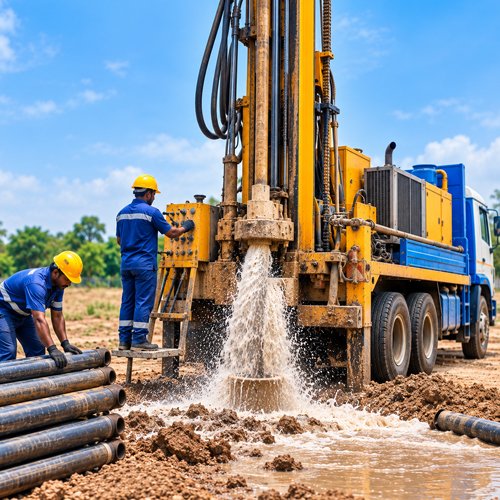
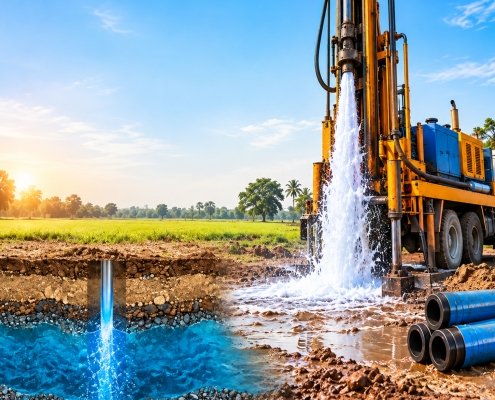
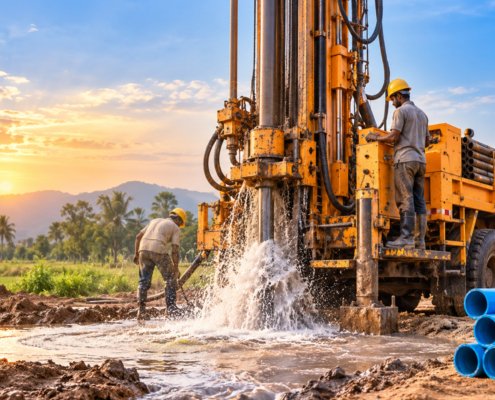
Reliable borewell drilling contractor delivering accurate, efficient, and professional groundwater solutions.
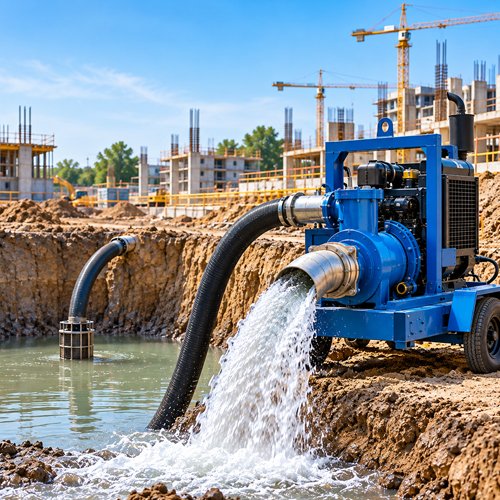
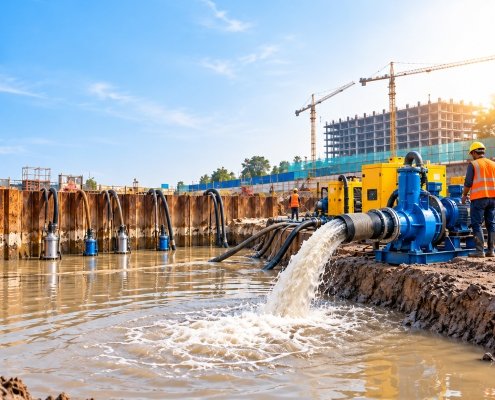
Efficient dewatering services provide safe, dry, and stable construction sites with reliable groundwater management solutions.
Effective rainwater harvesting systems conserve water and improve groundwater recharge for sustainable water management.
Strong pile foundation solutions provide stability, support, and durability for demanding construction projects.
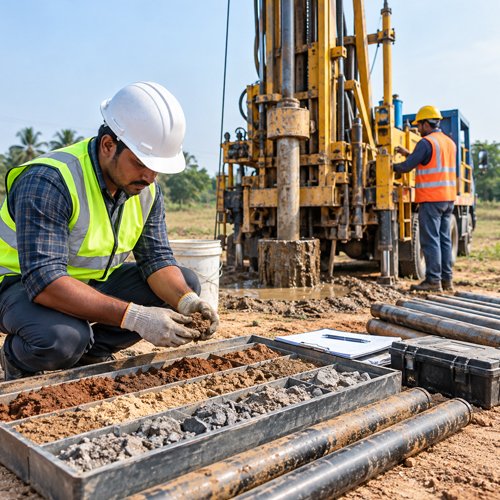
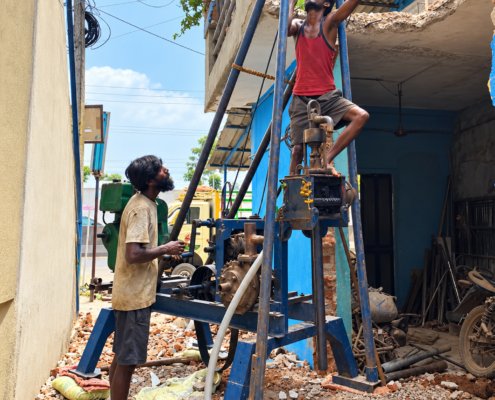
Accurate soil testing evaluates ground conditions, strength, and suitability for safe, durable construction foundations.
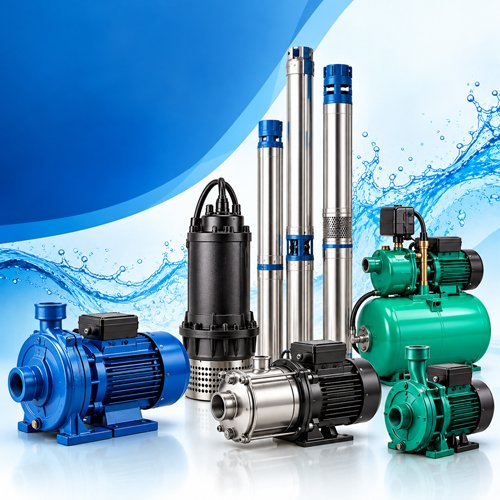
Reliable pump sales and service provide efficient water solutions, installation, maintenance, and expert repairs.
VS Borewell soil testing project generally follows these stages:
Depending on the nature of the project, soil testing can be conducted using applicable Indian Standards and other recognized test methods.
The IS 2720 series covers several soil-testing methods. For example, Redhills laboratories advertise soil testing under IS 2720, including CBR, compaction, Atterberg limits, grain-size analysis, and other geotechnical tests.
For environmental testing, the applicable standard or regulatory method should be selected according to the parameter, intended use of the report, and regulatory requirement.
A soil testing report may contain:
For construction projects, the report should be reviewed by the responsible geotechnical or structural engineering team before being used for design decisions.
Construction soil testing is particularly important before starting:
A proper geotechnical investigation can help identify subsurface conditions and support foundation design. Redhills varied geology makes site-specific investigation important rather than assuming that soil conditions are identical across locations.
Agricultural soil testing helps determine whether the soil has suitable nutrient and chemical characteristics for a particular cultivation plan.
Testing can identify:
The resulting information can support more efficient fertilizer management and soil-health planning.
The cost of soil testing in Redhills varies depending on the type and number of tests, sample quantity, field investigation requirements, project size, reporting requirements, and whether testing is performed in a laboratory or at the site.
Current online Redhills listings show individual soil-testing services at different price points, including listings around ₹5,000 for certain soil-testing services and lower prices for individual tests; these are indicative marketplace listings rather than fixed market rates.
For example:
| Service Type | Indicative Pricing Approach |
| Basic soil analysis | Depends on selected parameters |
| Agricultural fertility testing | Usually charged per sample/package |
| CBR testing | Charged according to sample/test requirement |
| Compaction testing | Laboratory/field dependent |
| Soil resistivity testing | Site and test configuration dependent |
| Geotechnical investigation | Depends on borehole depth and field tests |
| Environmental soil testing | Depends on number of chemical parameters |
Always request a project-specific quotation rather than comparing prices based only on a single test.
Before selecting a soil testing service provider, consider:
Soil testing providers can serve projects across major Chennai locations and surrounding industrial and suburban areas, including:
Several Chennai soil-testing and environmental laboratories operate from industrial and commercial locations such as Guindy, Ambattur, Pallavaram, and other parts of the Chennai region.
VS Borewell Soil Testing Services in Redhills provide valuable technical information for construction, agriculture, infrastructure, industrial development, pavement projects, and environmental assessment. From basic soil classification and fertility analysis to advanced geotechnical and contamination testing, the correct test package should be selected according to the project’s objectives.
For construction projects, soil testing can support foundation, pavement, earthwork, and site-development decisions. For agriculture, it can help identify nutrient and pH conditions for better soil-management planning. Environmental soil analysis can additionally help identify contaminants and support appropriate land-use or remediation decisions.
When selecting a provider, compare the laboratory’s relevant accreditation scope, testing methods, technical expertise, sampling procedures, reporting format, turnaround time, and project-specific quotation. Request a Soil Testing Services in Redhills quotation based on your exact testing requirements for a more accurate assessment of cost and deliverables.
Soil testing provides information about the physical and engineering characteristics of the ground, helping engineers assess foundation and earthwork requirements.
Common tests include moisture content, grain-size analysis, specific gravity, Atterberg limits, compaction, CBR, shear strength, permeability, and consolidation, depending on the project.
CBR or California Bearing Ratio testing evaluates the strength characteristics of soil and is commonly used for pavement and road-related applications.
Agricultural soil testing evaluates soil fertility parameters such as pH, electrical conductivity, organic carbon, nitrogen, phosphorus, potassium, and micronutrients.
There is no single fixed price. Cost depends on the test parameters, number of samples, field investigation, project requirements, and reporting requirements. Online Redhills listings show different prices for different testing packages and individual tests.
Turnaround time depends on the type and number of tests. Some commercial listings quote a few days for selected soil-analysis services, while larger geotechnical investigations can take longer.
Yes. Depending on the laboratory’s testing scope, soil can be analyzed for heavy metals, pesticides, petroleum-related compounds, and other contaminants.
It can be important when a project requires accredited results for contractual, regulatory, or compliance purposes. Always verify that the specific soil test required is included within the laboratory’s current NABL scope.
Yes. Soil investigation and testing can provide useful information for residential foundation planning and other site-development decisions.
Provide the site location, project type, approximate site area, number of samples or boreholes if known, required tests, project stage, reporting requirements, and desired turnaround time.